DCSA Reference Documentation / Standards / Standard Releases / Commercial Schedules / Archive / Commercial Schedules v1.0.2
DCSA CS 1.0.2 - Purpose & Scope
Archived release: Commercial Schedules v1.0.2 has been superseded. View the current v1 documentation.
This page is republished as part of the complete documentation set for this version. No content changes have been made from the 1.0.1 version.
Contents
Introduction
Preface
DCSA envisions a digitally interconnected container shipping industry. Our mission is to be the de facto standards body for the industry, setting the technological foundation for interoperable IT solutions. Together with our member carriers, DCSA creates vendor-neutral standards for IT and non-competitive business practices. By working towards the widespread adoption of these standards, our aim is to move the industry forward in terms of customer experience, efficiency, collaboration, innovation and respect for the environment.
The objective of DCSA is to strengthen the container shipping industry’s ability to send and receive data across all parties in the industry. Furthermore, it aims to enhance inter-carrier cooperation based on shared requirements and to ensure interoperability by using a shared data language. This language is inspired by existing standards and is aligned with the industry process definitions put forth in the DCSA Industry Blueprint.
Apart from the reliance on a small set of widely used open-source technologies and standards (e.g. JSON, REST, OpenAPI), the standards published by DCSA are technology agnostic.
This chapter describes the purpose, scope and supporting publications of this document.
Purpose
The objective of the DCSA Interface Standard for Commercial Schedules is to standardise the communication between publishers (e.g. carriers, solution providers) and the receivers of schedules (e.g. BCOs, Logistics Service Providers, and Solution Providers), as related to obtaining point-to-point routings, port schedules, or vessel schedules. In doing so, this publication supports the standardisation of the fundamental information exchanged between these parties.
This publication focuses on creating agreement around the functional and data standards needed to enable seamless interoperability between industry participants. By aligning these requirements, all adopters of the standard will offer consistent interface behavior and data formats, eliminating the need for custom integrations. The standard must therefore be implemented in a 100% conformant way by every adopter in the ecosystem.
Scope
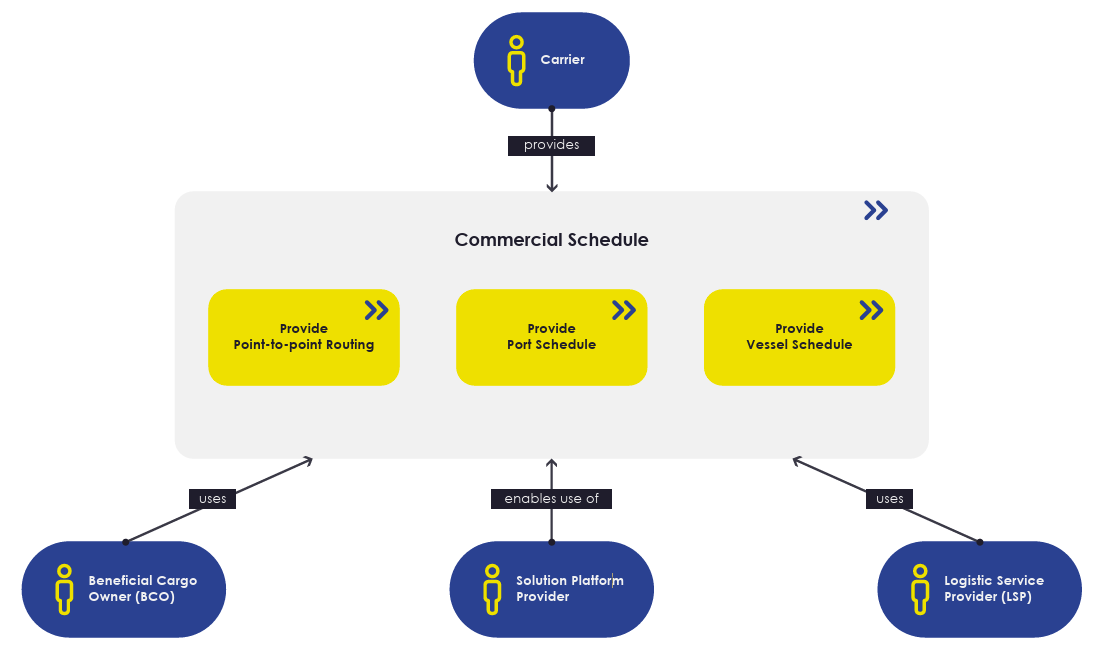
Commercial Schedules encompass various types of schedules and information that carriers could provide to Beneficial Cargo Owners (BCO), Logistics Service Providers (LSP), and Solution Platforms for commercial purposes. DCSA defines standards for three types of commercial schedules:
- Commercial schedules – point-to-point routing: provides the product offering of single or multiple estimated end-to-end route options for a shipment in the pre-booking phase. This includes point-to-point specification of all transport legs, estimated timings, estimated schedules, and interdependencies between transport legs.
- Commercial schedules – port schedule: provides, for a required specific port and starting date, the set of all vessels arriving and departing from the port with the corresponding estimated timestamps.
- Commercial schedules – vessel schedule: provides, for a required specific service and/or voyage and/or vessel and/or location, the timetable of estimated departure and arrival times for each port call on the rotation of the vessel(s).
Supporting publications
This Interface Standard document is supported by a range of supplementary DCSA publications. The supporting publications are listed in the table below and can be found on the DCSA website.
| Publication | Description |
|---|---|
| DCSA Information Model 2024. Q3 | This document has been created to organise and catalogue the information being generated or consumed in connection with the processes described in the DCSA Industry Blueprint. The Information Model is also used as a collective term to describe all products that model data. It includes a diagrammatic representation of selected data entities and their relationships with one another. |
| DCSA Shipping Glossary of Terms | This document explains international container shipping terminology used within the industry, fostering communication and promoting standardisation among stakeholders. |
| DCSA Industry Blueprint 2023. Q4 | This document consists of a compilation of business processes that are considered critical for industry digitalization and standardisation efforts, and that are not considered commercially sensitive or of competitive advantage. It offers an accessible way to understand the container shipping industry by providing industry-approved processes and data definitions. Additionally, it visually demonstrates the domains where DCSA’s standards are applied. |