DCSA Reference Documentation / Standards / Standard Releases / Operational Vessel Schedules / Archive / Operational Vessel Schedules v3.0.1
DCSA OVS 3.0.1 - Definitions
Archived release: Operational Vessel Schedules v3.0.1 has been superseded. View the current v3 documentation.
Contents
- Purpose
- Preface
- Change history
- Introduction
- Schedules definitions
- Appendix
Purpose
This DCSA document aims to standardise the terminology, definitions, and processes concerning the communication of operational vessel schedules between partners.
The definitions of terms used in this document can be found in the Glossary of Terms available on the DCSA website.
Preface
DCSA envisions a digitally interconnected container shipping industry. Our mission is to be the de facto standards body for the industry, setting the technological foundation for interoperable IT solutions. Together with our member carriers, DCSA creates vendor-neutral standards for IT and non-competitive business practices. By working towards the widespread adoption of these standards, our aim is to move the industry forward in terms of customer experience, efficiency, collaboration, innovation, and respect for the environment. Please refer to the DCSA website (https://dcsa.org/about/ ) for more information.
This document is a publication about the definitions for Operational Vessel Schedules from DCSA. The aim of the DCSA Definitions for Operational Vessel Schedules is to ensure that all members and partners in the container shipping industry can gain a common understanding of the data and processes of the industry to enable consistency, simplicity, and timeliness in the solutions for vessel schedules across the industry, supporting interoperability in container shipping.
The standards published by DCSA are technology agnostic. DCSA does not point to the use of specific vendors’ technologies or systems but relies on open-source, shared requirements for the industry that can be used by all parties, regardless of their choice of technology.
Change history
| Version | Date | Description |
|---|---|---|
| 1.0 | 2020 | DCSA Operational Vessel Schedules Definitions |
| 3.0.0 Beta | Jun 2022 | DCSA Operational Vessel Schedules Definitions - Universal References: Inclusion of Service, Voyage, and Port Call References to standardise and improve communication between operational partners sharing Operational Vessel Schedules in the container shipping industry. - Just-in-Time Port Call definitions have been addressed in a separate document since 2021 by DCSA. |
| 3.0.0 Final | Dec 2023 | DCSA Operational Vessel Schedules Definitions - Update on Universal Service References implementation - Update of Universal Voyage References alphanumeric sequence (clarification) - Update of Universal Voyage Reference bounds, allowing now to use Roundtrips (R) - Suggested practices for Universal Voyage Reference implementation |
| 3.0.1 | Oct 2025 | - Update on Universal Port Call Reference use as defined in this document: the suggested format is no longer encouraged to be used. - Update on Dummy Vessels suggested naming - Added to changes and exceptions: Dry dock, Layby, Bunker call |
| 3.0.1 | June 2025 | - Added support to share Estimated Time of Arrival at Pilot Boarding Place - Updated business processes by linking directly to Industry Blueprint |
Introduction
Scope of this publication
This document aims to standardise the terminology, definitions, and processes, concerning the communication of operational vessel schedules between partners. This release of DCSA’s Operational Vessel Schedules covers the following aspects of vessel schedules for interregional, intraregional, and feeder services:
-
Long Term Schedule & Regional/Coastal Schedule
- Deep-sea (interregional services)
- Intraregional & Feeder Services
-
Where available, the operational vessel schedule may include estimated time of arrival information for the Pilot Boarding Place. This supports berth alignment between terminals and carriers, particularly in ports where the Pilot Boarding Place ETA is used as part of short-term or coastal operational schedule coordination.
-
Changes and Exceptions (i.e., Port Omission, Blank Sailing, Inducement, Phase In/Out, etc.)
-
Universal References
- Universal Service Reference
- Universal Voyage Reference
- Universal Port Call Reference
The purpose is to facilitate standardisation and accuracy in partner communications and hence reduce the pain points that have been raised in this area by carriers.
The purpose is to standardise what partners communicate and when (and to whom) concerning operational vessel schedules and related exception management.
The definitions and time specifications are meant to add context to the vessel schedule process maps.
Schedules definitions
| Schedule | Definition | Publishing |
|---|---|---|
| Proforma Schedule (PS) | Consists of the final port rotation with the planned time of arrival and departure for each port call. Partners agree/define the first load port of a region/voyage. | Not published. To be agreed upon before commencement of the service. |
| Master Schedule (MS) | A long-term view of the agreed Proforma Schedule including proforma dates of call, cycle, and agreed vessel sequence. The Master Schedule is fixed at a certain date and is to be used as a reference. | Not published. |
| Long Term Schedule (LTS) | An updated schedule, based on the final Proforma Schedule, including specific vessel & voyage numbers, is to be published at least 12 weeks ahead of the commencement of the individual voyage. It incorporates planned arrival and departures, and planned changes and exceptions (i.e., Phase-in, Phase-out of a vessel) | To be published before the commencement of each service. Provides sailings 12 to 14 weeks ahead. |
| Regional Schedule (RS) / Coastal Schedule (CS) | The updated schedule, based on the Long Term Schedule, that will be issued before arrival at the first port call in another region. Includes estimated port/terminal issues and any intended corrective actions to bring the schedule back to a Long Term Schedule, i.e., port omissions, speeding up, etc. An updated schedule will normally be published if a vessel deviates more than 12 hours from LTS or the latest published RS/CS. RS/CS can be published daily/weekly. | Recommended to be published (at the latest) 24 hours after departure from the previous region. |
Operational schedules should be updated in “real-time”, between partners, as changes materialise. Timelines for the publication of customer-facing changes (on websites, portals, etc.) should be agreed upon between VSA partners. DCSA provides a separate standard for sharing commercial schedules.
Intraregional and Feeder Services Schedules are based on the defined Long Term and Regional/Coastal Schedules, with the difference that for Intraregional and Feeder Services an updated schedule will normally be published if a vessel deviates more than six hours from its LTS or the latest published RS/CS – or earlier, if any delay or restriction are anticipated. Due to the dynamics of the feeder services operation, the part of the process for receiving comments from a VSA partner upon receiving an update to a schedule is excluded from the overall process.
Where available, the operational vessel schedule may include estimated time of arrival information for the Pilot Boarding Place. This supports berth alignment between terminals and carriers, particularly in ports where the Pilot Boarding Place ETA is used as part of short-term or coastal operational schedule coordination
End-to-End Operational Vessel Schedule processes
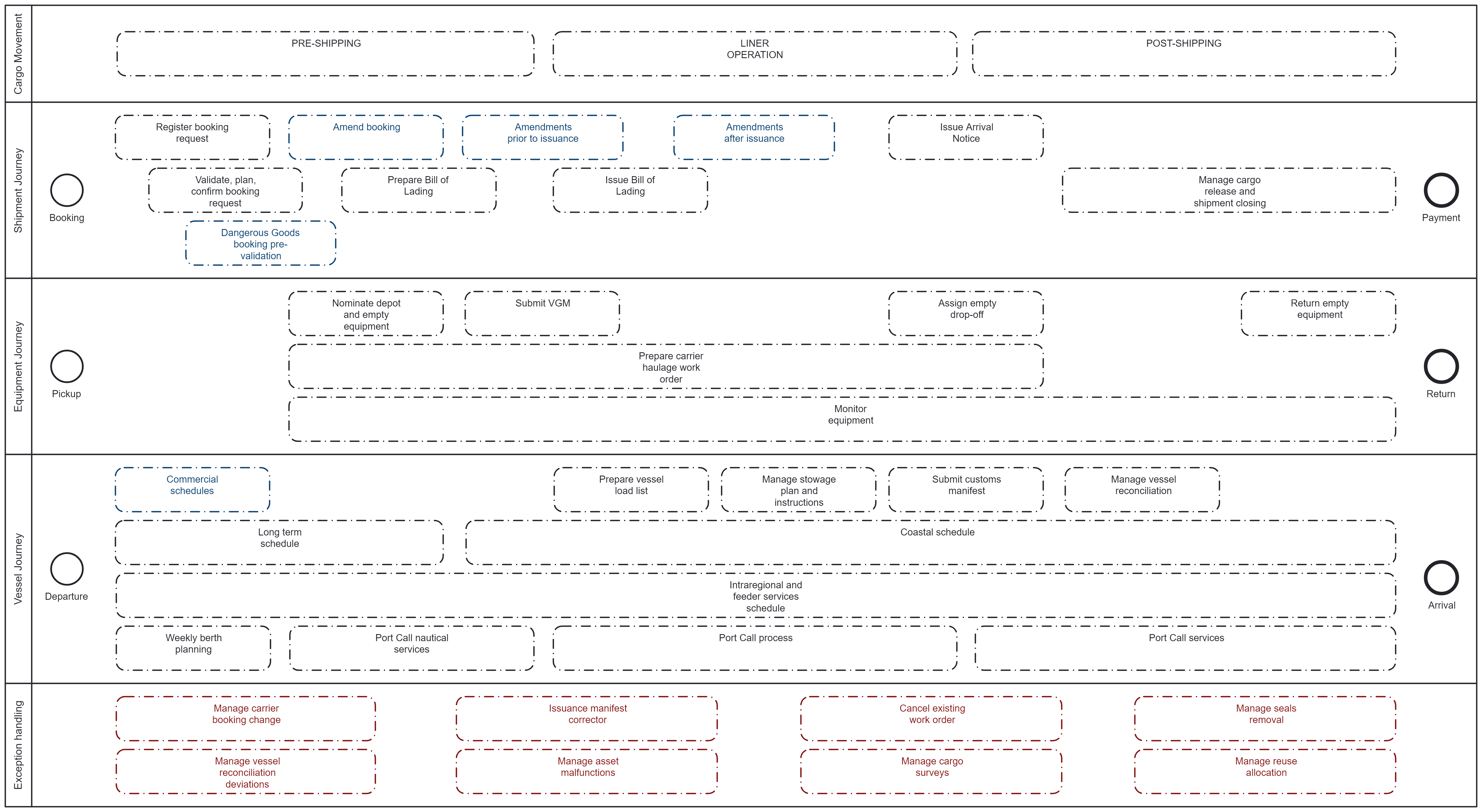
The end-to-end processes are presented in the images below and are available on the DCSA website in the Industry Blueprint Documents.
Blueprint
Link: /content/standards/industry-blueprint/current/industry-blueprint#processes-overview
 Long Term Schedule
Link: /content/standards/industry-blueprint/current/industry-blueprint-vessel-journey#long-term-schedule
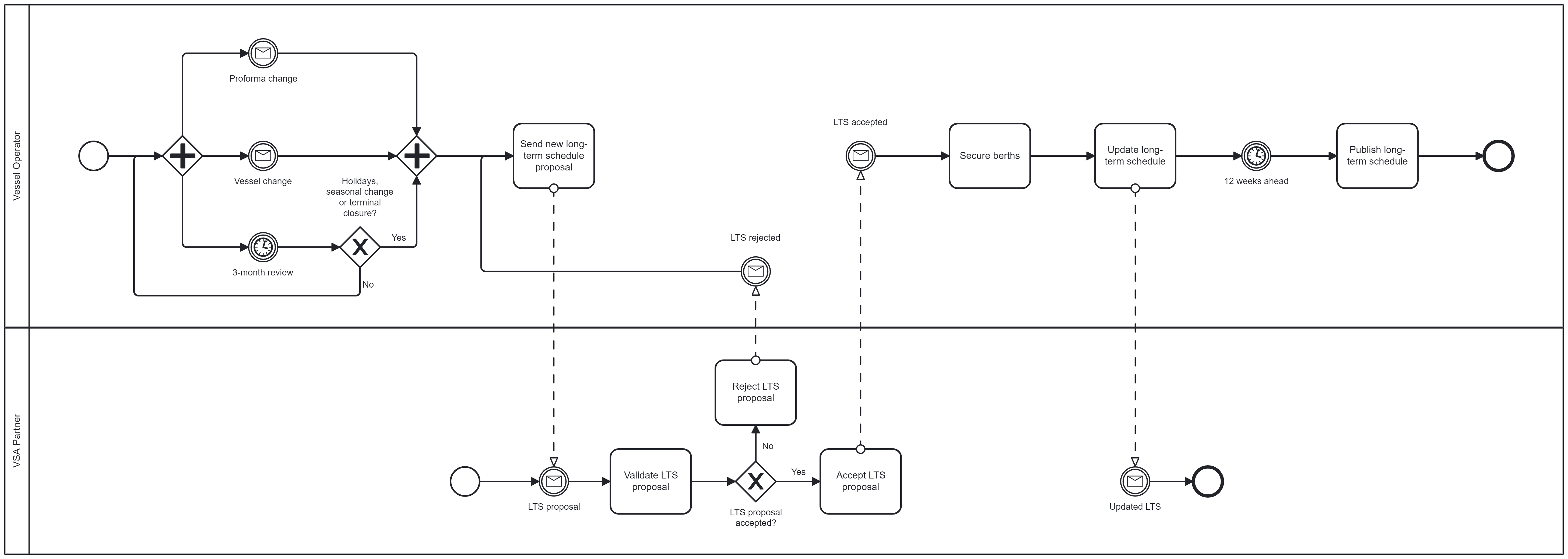 Long Term Schedule
Coastal Schedule
Long Term Schedule
Coastal Schedule
Link: /content/standards/industry-blueprint/current/industry-blueprint-vessel-journey#coastal-schedule
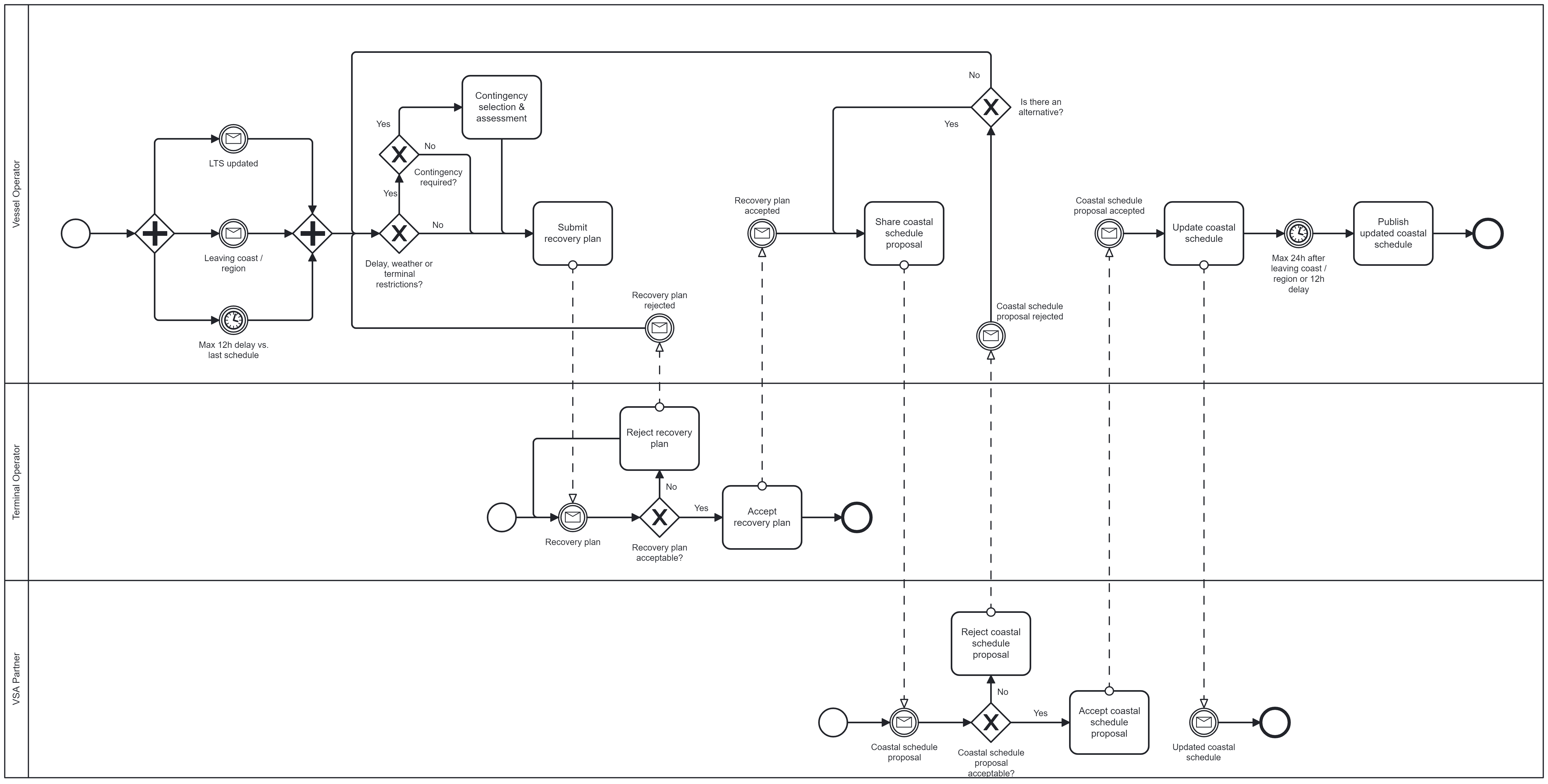 Coastal Schedule
Intraregional and Feeder Services Schedule
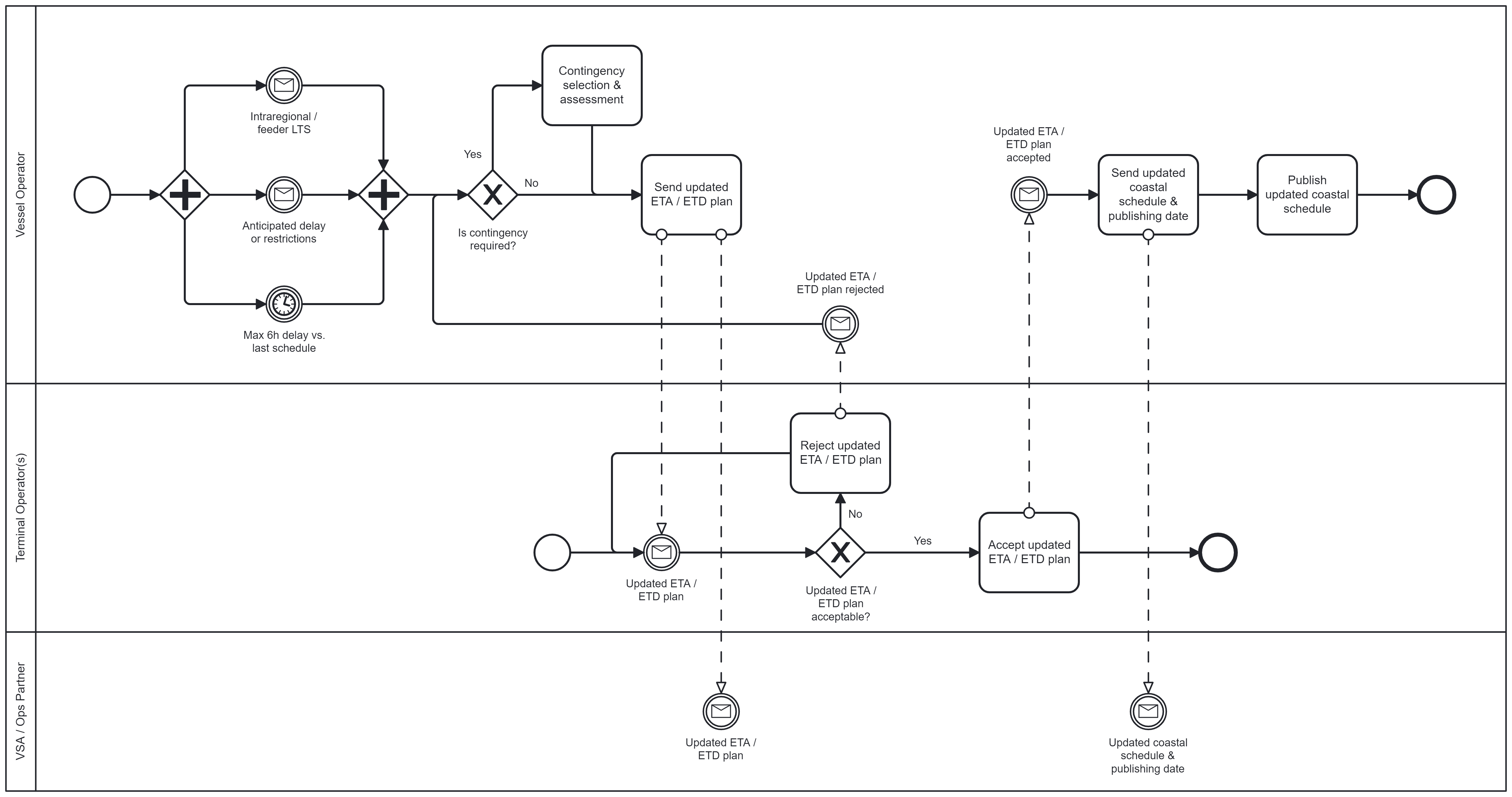
Events definitions
The foundation for creating operational transparency is to use a common language and established definitions for expressing timestamps.
Event Types
There can be two event types with timestamps in a schedule:
- Arrival is the event that occurs when a mode of transport reaches its final or intermediate destination, and the mode of transport is ready for load/discharge operations at the specified location. A vessel has arrived once the vessel is berthed at the port terminal with the first line ashore at the port terminal.
- Departure is the event that occurs when a mode of transport leaves a place of operations. A vessel has departed from a berth once the last mooring has been released.
Event Types Classification
Three versions of the timestamps can exist in a schedule event type:
- Planned is equal to the Long Term Schedule with a published rotation and named vessel. In cases where a vessel has not yet been nominated, it will be displayed as: “To be nominated” or with a dummy vessel.
- Estimated is equal to actual voyage data and could result from updates to the Coastal Schedule sent by partners.
- Actual is equal to the actual timestamp of the scheduled event, after it happened, as published by the partner.
Changes and exceptions in schedules
Schedule exceptions occur if, or when, a vessel is unable to maintain the intended schedule due to unforeseen events (i.e., weather, port congestion, technical issues, etc).
Port omission
When a ship omits a port call contained in the original schedule.
Planned (foreseen) cut-and-run operation
When a port call is reduced in time and move counts due to foreseen delay/congestion.
Unplanned (unforeseen) cut-and-run operation
When a ship stops its discharge/loading operations prematurely due to unforeseen events.
Inducement call (a.k.a. adhoc call)
An additional port call is made on a specific voyage that was not originally included in the Long Term Schedule.
Port call swap (a.k.a. rotation change)
When the vessel’s port call rotation sequence is changed after the publication of the Long Term Schedule.
Blank sailing
When an already announced voyage is cancelled.
Phase out
When a vessel moves out from a service at a given port, to the latest issued schedule.
Phase in
When a vessel moves into service at a given port from the latest issued schedule.
Slide
When a vessel takes another position than planned in a service (i.e., due to a relevant delay), resulting in one or more voyages being cancelled or blanked.
Drydock
When a vessel is put into dry docking for essential maintenance, repairs, and inspections to ensure it is safe and seaworthy.
Layby
When a vessel goes out of service
Bunker Call
When a port call is added that was not in the proforma, only for bunkering, not for load+discharge operations.
Service, Voyage, & Port Call
Definitions
- Service: The roundtrip sequence of ports being served by a (number of) vessel(s) on a specific Proforma (schedule). Synonyms are rotation, loop, or string. A Service is defined by rotation, transit times, weekdays of departure per port, and frequencies.
- Voyage: A part of a service roundtrip that normally changes at the geographical “end-point” of a vessel rotation, and as such, that specific port call can have two voyages – one for the discharge of final shipments on the “current” voyage, and a new voyage number identifying the start of loading shipments (for allocation purposes). One vessel rotation will normally have two voyages, one on each haul (East, West, North, South), or eventually a single Roundtrip voyage. Each voyage consists of a minimum of two ports.
- Port call: This is a unique intermediate stop of a vessel in the rotation of ports on a voyage. A vessel may have several terminal calls during a single port call.
Example: Service with 2 Voyages (Eastbound and Westbound), and 5 Portcalls
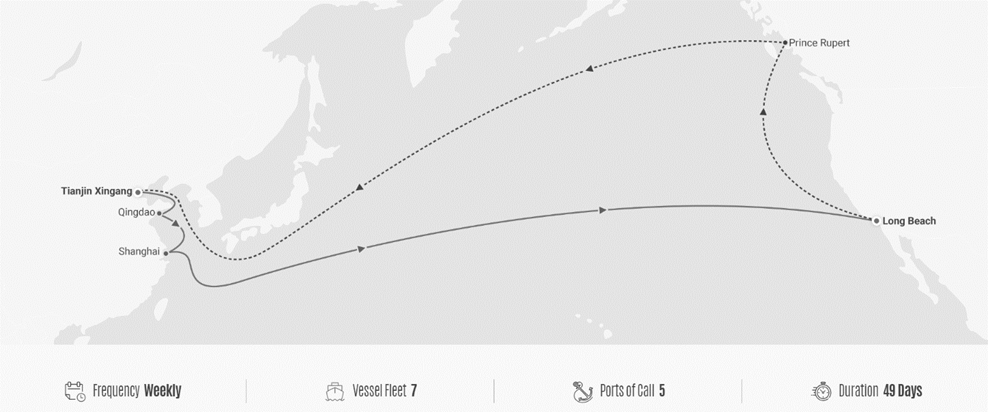
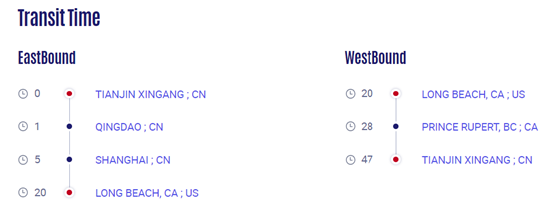 Source: Asia - North America WC Service – Ocean Alliance - CMA
Universal References for: Service, Voyage, and Port Call
Objective
This document contains DCSA’s proposed logic to achieve a globally consistent way of creating universal references for three key operational identifiers that follow a hierarchical structure:
- Service
- Voyage
- Port call (and terminal)
The aim is to standardise and improve communication between operational partners sharing Operational Vessel Schedules in the container shipping industry.
The proposed logic is based on input from DCSA members and others. The design criteria for the references focus on simplicity, ease of integration with existing systems, and human readability.
The document also contains basic definitions to remove potential ambiguity in the implementation.
Scope and benefits
Based on workshops with members to understand the pain points in current processes for exchanging schedules between parties, the following benefits were identified and agreed for Universal References:
- Common reference: Clearly refer to a specific Service across all carriers, thus speaking the same language.
- Clear identification: Any partner can find the relevant voyage and port call identifier based on a Universal Service Reference, thus allowing interoperability between systems.
- Efficient scheduling: Improved quality of schedules, shared with partners.
- Effective communication: No more ambiguity on port calls.
- Optimised costs: Overhead costs, e.g., IT development requires a one-time setup, optimization of billing or invoicing processes, etc.
Universal References are an agreed coding system for operational identifiers on top of current service names and codes, and voyage numbers, that will allow carriers and other stakeholders to reduce errors when referring to services and their voyages.
The goal is to substitute the mid-term current carrier and alliance-specific internal naming logic with Universal References and promote an industry-wide approach to refer to operational services, voyages, and port calls.
Initially, logic should apply to alliance-operated and VSA services, and over time, to individually operated carrier services (main haul and intraregional), and feeder services (internal and 3rd party).
Gradually, the logic and naming convention can be adopted commercially by carriers and alliances.
Universal Service Reference
Most larger container shipping carriers participate of alliances or VSA. This highlights the need to share and store definitions outside the traditional boundaries of each carrier and has, over time, resulted in a multitude of mapping and conversion tables – in order to achieve a consistent definition and identification of services.
Universally referring to a service across carriers will enable more efficient communication between vessel operators, ports, and terminals, and eliminate the need for internal mapping and conversion tables.
A Service Reference should reversely map into an individual carrier’s commercial service name; thus, allowing members to link the internal translation table to a Universal Service Reference.
Format for Universal Service Reference
The Universal Service Reference (USR) as defined by DCSA is composed of the letters SR followed by 5 digits, followed by a checksum character from A to Z. A service reference can look like, for example, SR0000X.
SR + 5 numeric digits [0..9] + check character [A..Z]
DCSA distributes USRs to DCSA members and non-members, ensuring that each USR is assigned only once and belongs to only one carrier. If a carrier runs out of available USRs because they have all been used in services, a new batch can be requested from DCSA.
In the short term, carriers will hold a set of USRs in no specific order or range size, enough to cover the services they provide
With a total of 99.999 USRs that can be distributed, they are expected to be enough to cover all current and future services from members and non-members who choose to adopt USRs.
Any carrier or alliance is allowed to ask for a range of USRs from DCSA.
USRs can be implemented in the DCSA API or in EDI messages (see SMDG).
Implementation and Changes of Universal Service Reference in a VSA
Carriers must align with partners to use USRs in their shared services.
The Universal Service Reference can change due to VSA partners’ needs.
It is the responsibility of VSA partners to decide who is responsible for the lifecycle of the Universal Service Reference.
It is the responsibility of VSA partners to decide when a Universal Service Reference requires to be changed.
High-level process for distributing USRs to DCSA members and non-members
- Carriers assign responsible parties to request and manage USRs on their side
- The responsible parties are registered with DCSA (reach out to DCSA.org)
- A batch of USRs covering existing services is requested to DCSA, considering some room for potential new services
- The USRs are received
High-level process for assigning USRs to services
Shared services:
-
Receive the USRs from DCSA
-
Update master data to support the USRs
-
Integrate the USRs in the scheduling system (and other systems as needed)
-
Update the Joint Working Procedures in agreement with partners
- Decide in mutual agreement with carriers that they will provide the USR for each service in the Joint Working Procedures
- Assign the USR for each service
Non-shared services:
- Receive a USR from DCSA
- Update master data to support the USR
- Integrate the USR into the scheduling system (and other systems as needed)
- Assign a USR for each service
Reasons to use a new USR, reassign a USR, or request more USRs:
- New service is created
- Split service
- Change of rotation
- Commercial reasons
- Others
Example of USRs
| Service | Carrier 1 | Carrier 2 | Carrier 3 | USR |
|---|---|---|---|---|
| Asia – Europe | Carrier 1 Service Code XX2 | Carrier 2 Service Code YYYY2P | Carrier 3 Service Code Z3Z4Z | SR12345X (Reference managed by Carrier 3) |
| Oceania - Asia | Carrier 1 Service Code UY3 | Carrier 2 Service Code IYOP22 | - | SR54321W (Reference managed by Carrier 1) |
Universal Voyage Reference
The Universal Voyage Reference assumes that in container shipping a vessel is always assigned to a service, and a voyage is always assigned to a vessel (even if the vessel is a dummy vessel or barge without an IMO at some point in time), regardless of whether it is an ad hoc voyage, as an extra-loader, or assigned continuously. As such, the Service Reference is a prerequisite for the Voyage Reference and a voyage can only be identified by locating the Service. A voyage, typically (not always, nor prescribed), starts at the extreme geographical “start and end” point of a service rotation.
The sequence number is determined incrementally starting from the first voyage of the year and at the first port of call on the service (measured in local time). The sequence number is for the vessel roundtrip, only the direction changes at the endpoint of the voyage. (i.e., 2107W = year 2021 / voyage number 7 / Westbound – see format below).
The Voyage Reference will initially be generated by vessel operators when sharing their Long Term Schedule, in coordination with VSA partners. In cases where the vessel has not yet been nominated a dummy vessel “TBN” (to be nominated) will be provided for the vessel. The dummy vessel name and IMO should be updated before the start of the voyage. A Voyage Reference can be generated automatically once a Service Reference is generated, minimizing manual updates. However, there is the flexibility to manually change the Voyage Reference when required for operational reasons.
Format for Universal Voyage Reference
The Universal Voyage Reference has been restricted to 5 digits to comply with US customs requirements:
Year [YY] + Sequence [0..9 & A..Z] + Bound [EWNSR]
-
2 digits identifier for the year (e.g., 23 = 2023)
-
2 alphanumeric characters for the sequence number of the voyage (e.g., 10 = 10, A0 = 100, etc.)
- See appendix for full table with logic for sequence numbers to cover from voyage 01 to 1295 in a year
-
1 character identifier for the direction/haul [import/export] (i.e., E = East)
- E = East
- W = West
- N = North
- S = South
- R = Roundtrip
UVRs can be implemented in DCSA API or in EDI messages (see SMDG).
Overlapping ports during voyages
The reference allows for overlapping ports within a voyage. However, it remains the responsibility of the VSA partners to agree on the Import Voyage start point, the Import Voyage end point, the Export Voyage start point, and the Export Voyage end point.
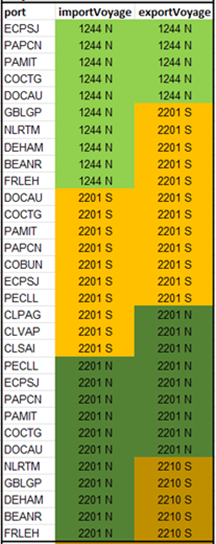 Example:
- Import Voyage start point: DOCAU
- Import Voyage end point: FRLEH
- Export Voyage start point: GBLGP
- Export Voyage end point: PECLL
High-level process for assigning UVRs to voyages
Shared services:
-
Master the data update to support UVRs
-
Integrate UVRs in the scheduling system (and other systems as needed)
-
Update joint Working Procedures in agreement with partners
- Decide in mutual agreement
- Assign the UVRs to voyages when creating services
Non-shared services:
· Master the data update to support UVRs
· Integrate UVRs in the scheduling system (and other systems as needed)
· Assign UVRs to voyages when creating services
Example of a UVR
| Service | Carrier 1 | Carrier 2 | Carrier 3 | USR |
|---|---|---|---|---|
| Asia – Europe | Carrier 1 Service Code XX2 | Carrier 2 Service Code YYYY2P | Carrier 3 Service Code Z3Z4Z | SR12345X (Reference managed by Carrier 3) |
| Voyage | Carrier 1 | Carrier 2 | Carrier 3 | UVR |
| Voyage N Operated Carrier 1 | 304E | 04FENW1MA | V354E | 2304E |
| Vessel | IMO8712345 | IMO8712345 | IMO8712345 | IMO8712345 |
| Voyage N+1 Operated Carrier 2 | 305E | 05FENW1MA | V355E | 2305E |
| Vessel | IMO8712368 | IMO8712368 | IMO8712368 | IMO8712368 |
Note: Service Codes, Voyage Numbers, and Vessels are just examples.
Universal Port Call Reference
When parties (relevant port-call actors, including authorities) exchange data concerning the activity of a vessel calling a terminal, the exact call must be identified uniquely (in conjunction with service, vessel, and voyage) and consistently, and the standardised identifier must be used for all exchanges – it can also serve as an internal identifier, if the parties so choose.
Update: In the OVS API Specification, it is present under the property name “transportCallReference: The unique reference for a transport call. It’s the vessel operator’s responsibility to provide the Transport Call Reference; other parties are obliged to pick it up and use it. It can take the form of Port Call References as defined in the OVS Definitions Document (this document), or a reference as defined by the vessel operator”. In practice, carriers provide their own vessel-operator-defined references since the release of the standard, and the below format of Universal Port Call Reference is no longer encouraged to be used.
Format for Universal Port Call Reference
5 Digits (UN Country Code + UN Port Locode) + 1 Digit (Port sequence: sequence related to the number of times a port is visited in a rotation in the LTS) + 1 Digit (Terminal sequence: sequence related to the order in which the terminals are caller in the port)
Example
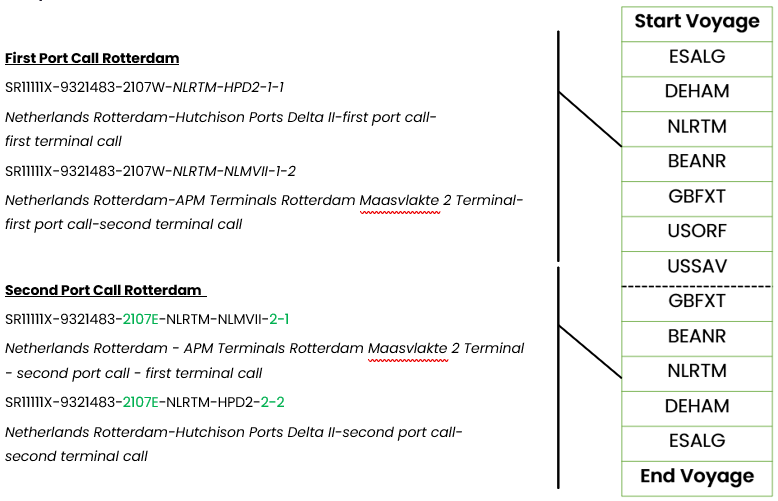 In the example, in service SR11111X, the Port of Rotterdam is visited twice in the rotation of vessel 9321483, the first time in voyage 2107W and the second time in voyage 2107E.
In the first time (2107W), the terminal Hutchison Ports Delta II is called first and the terminal APM terminals Maasvlakte 2 Terminal is called second.
In the second time, the APM terminals Maasvlakte 2 Terminal is called first, and the terminal Hutchison Ports Delta II is called second.
A port call reference (e.g., NLRTM-NLMVII-2-1) can repeat across voyages in the same service; is the combination of USR-IMO-UVR and a Port Call Reference that is unique.
If an “Inducement call” is introduced before, between, or after existing same port visits in the rotation, the port call reference shall continue the sequence. In the example, if a visit to Port of Rotterdam is induced and only terminal NLMVII is visited, the Port call reference would be NLRTM-NLMVII-3-1, which in combination with USR-IMO-UVR, would be unique.
When sharing vessel schedules, the list of port visits and terminal calls will be ordered with the sequence they will follow in reality, regardless of the initial (in LTS) or afterward (i.e., inducement) assigned reference.
Service and Voyage exception use cases and suggested practices with UVR
Butterfly Service
When a service contains ports that are called at a fortnightly frequency, it generally occurs when two services are merged allowing to reduce the frequency by half for some of the ports. It can also simply be defined as is a route with at least one port visited twice in a round trip (termed as ‘Butterfly Port’), with the Butterfly Port visited more than one time in the same or a different direction.
Suggested Practice: Utilise the port visit reference and transport call reference (port call reference) in the OVS Interface Standard to distinguish between port calls. While the OVS Interface Standard doesn’t enforce a specific format, these OVS definitions propose a recommended format for Port Call Reference to be used in the Transport Call Reference data attribute. At predetermined points in the voyage, carriers should either increment the voyage sequence or alter the bound as agreed upon.
Non-Weekly Service
In cases where for example, feeder services conduct several roundtrips per week, the identifier for the voyage is a sequence number.
Suggested Practice: UVR to follow the sequence as per carriers practice or as agreed in joint working procedures (JWP) with partners. The 2 characters with a defined alphanumeric sequence logic, applied to traditional week count or not, allows for 1295 voyages in a year. See appendix for sequence logic.
Tandem Service
Tandem services occur when two (smaller) vessels replace one (bigger).
Suggested practice: There should be 2 different voyage numbers or UVR when there are 2 different vessels. One vessel can adopt the existing UVR in the long-term schedule, resulting in the creation of a single additional new voyage for the other vessel. Alternatively, two new voyages can be generated.
New Voyage in between existing voyages
When a voyage is introduced in between existing voyages of a service (i.e., a tandem is introduced after the long-term schedule is published).
Suggested practice: Use available voyage number as per carrier practice and use a UVR from the end of the sequence.
Blank Sailing
When an already announced voyage is cancelled.
Suggested practice: The UVR can be retained and port calls are blanked.
Phase In / Phase Out
When a vessel moves into a Service at a given port from the latest issued schedule, or when a vessel moves out from a service at a given port from the latest issued schedule.
Suggested practice: If the vessel phases in between turning ports of the voyage, the new vessel will normally re-use the same UVR code from the leaving vessel. If the vessel phases in at the turning point, the new vessel will normally use the next voyage of the original vessel as planned in the long term schedule.
Port Omission
When a ship does not call at a port (terminal) included in the Long Term Schedule that was planned at the start of the voyage.
Suggested practice: No changes to UVR, port (terminal) is just omitted.
Planned (foreseen) / Unplanned (unforeseen) cut and run operation
When a port call is reduced in time and move counts due to foreseen delay/congestion or when a ship terminates its discharge/loading operations prematurely due to unforeseen events.
Suggested practice: No changes to UVR.
Inducement call or Ad Hoc call
An additional port call made on a specific voyage that was not originally included in the Long Term Schedule.
_**Suggested practice: **_No changes to UVR. The Port (terminal) is added to the port calls sequence.
Port call swap (a.k.a. Rotation Change)
When the vessel’s port call rotation sequence is changed after the publication of the Long Term Schedule.
_**Suggested practice: **_No changes to UVR.
Slide
When a vessel takes another position than planned in a service (i.e., due to relevant delay), resulting in one or more voyages being canceled or blanked.
Suggested practice: Create a new voyage for the vessel or reassign an existing voyage
Dummy Vessel
In cases where a vessel has not yet been assigned to a specific voyage, but the carrier knows that a voyage will take place. A TBN (To Be Nominated) vessel can be used to identify dummy vessels; in this scenario, the schedule shall demonstrate that the vessel being used for the schedule is a dummy vessel (this is taken in consideration in the OVS API Specification). Thereby, also eliminates the need for using the IMO number to identify vessels, which in the case of dummies is non-existent. For example: Service: SR33333X / Vessel: TBN (dummy) / Voyage: 2107W – Service: SR33333X / Vessel: TBN (dummy) / Voyage: 2108W
In case the vessel is a “dummy vessel” then the following recommendations should be followed:
Dummy vessel names should begin with the SMDG Operating Carrier Code to ensure uniqueness across carriers. The suffix can be alphanumeric and up to 10 characters long, allowing each carrier to use internal naming conventions (e.g., MSKTBN1, CMATEMP01, MSCX01A).
This approach:
- Ensures consistency and uniqueness across carriers
- Allows flexibility in local implementations
- Avoids the need to assign dummy IMO numbers
- Maintains the role of the dummy vessel name as a stable and persistent identifier throughout the planning process
The above suggestions for Universal Voyage Reference utilization can also be applied to current voyage numbers used by carriers.
Schedule reliability
The “schedule reliability score” is calculated by dividing the number of port call arrivals at berth performed “on time” by the total number of calls for the same period.
The port call is considered performed “on time” if arrival at berth is within -/+24 hours compared to the Long Term or Regional Schedule arrival at berth time. Measurement should be made based on a rolling frozen view of the Regional Schedule 14 days in advance of the port call if different from the Long Term Schedule. If only the date (and not time) is communicated in the schedules, a default arrival time of midnight local time will be used.
Berth time is defined as first line ashore at the first terminal called in the port. In case of multiple terminals called in one port, only the first terminal will be counted.
The port call is not considered “on time” if the delay at berth is more than 24 hours, or if the call occurs more than 24 hours earlier, regardless of the reason for the delay/anticipation.
The call is not considered “on time” if it is not performed (i.e., port omitted), and if this port omission was not reflected in the Regional Schedule a minimum of 14 days before the planned arrival.
Inducement (ad hoc) calls are included in the measurements but always counted as “on-time” if they are performed as published in the Regional Schedule a minimum of 14 days before the planned arrival.
Seasonal cancellations and holiday closures are not counted towards measurements in cases where they are agreed prior to the start of the voyage (start of loading at the previous region). This means that the Master and Long Term Schedule will need to be updated prior to the start of the voyage, for the actual arrival to be measured against the adjusted expected arrival time. “Start of voyage” is defined as the departure date in the first operative port of loading.
For shared services, schedule reliability should be measured both per individual vessel operator and at a service level.
- Individual vessel operator view: use only the vessel operator’s schedule. If operator A has 5 vessels and operator B has 3 vessels in a given service, then reliability for A is measured based on the performance of 5 vessels and for B is measured based on 3 vessels. In both cases it is measured in all ports, which are called in the respective service.
- Service view: aggregate the reliabilities per operator (two in the above example) and apply this to the service (including slot charterers).
Example
Carrier A: 80% = (10 calls with 8 calls on time)
Carrier B: 50% =(8 calls with 4 calls on time)
Service: 66% = (18 calls with 12 calls on time)
Assignment to reporting period:
- A port call is assigned to the reporting period (for example, to the month) by the day of actual arrival at berth.
- A service is assigned to the reporting period by the departure date in the first operative port of loading in a voyage.
Average delays:
- Average delay of late vessels: only late vessels are considered in this calculation. This average does not contain any vessel arrivals that were either “on time” or early.
- Average delay of all vessels: this is the average delay of all vessel arrivals, both those that are late, as well as those that are “on time” or early. This means that the delays of the LATE vessels are effectively diluted y the early and “on time” arrivals. This figure could also be negative, meaning that on average, the vessels arrived early.
Example
If minus (-) means a vessel arriving early and plus (+) means a delay, and we have five vessels on a service arriving [-4, +3, -1, +2, -1], then the average delay of LATE vessel would be (2+3)/2=2.5 days, the delay of ALL vessels would be (-4+3-1+2-1)/5 = -0,2 days, while the schedule reliability would be 2/5= 40%, as only “on-time” arrivals are considered in this calculation.
The above definitions will be commonly and evenly applied to all ports, carriers, and alliances, independent of their size or throughput.
Appendix
Representation of Operational Vessel Schedules exchange
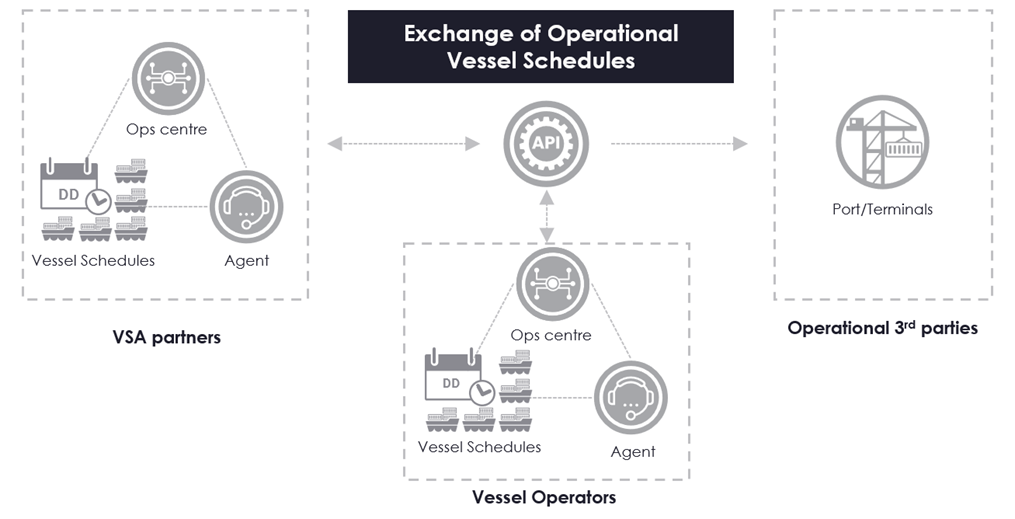 Illustration
Note: Other operational partners may take part in the exchange of schedules.
Illustration
Note: Other operational partners may take part in the exchange of schedules.
Logic for UVR sequence number
Logic for sequence Number from 00 to 1295 using two characters
Universal Voyage Reference sequence-number workbook
Download the Universal Voyage Reference alphanumeric sequence-number logic